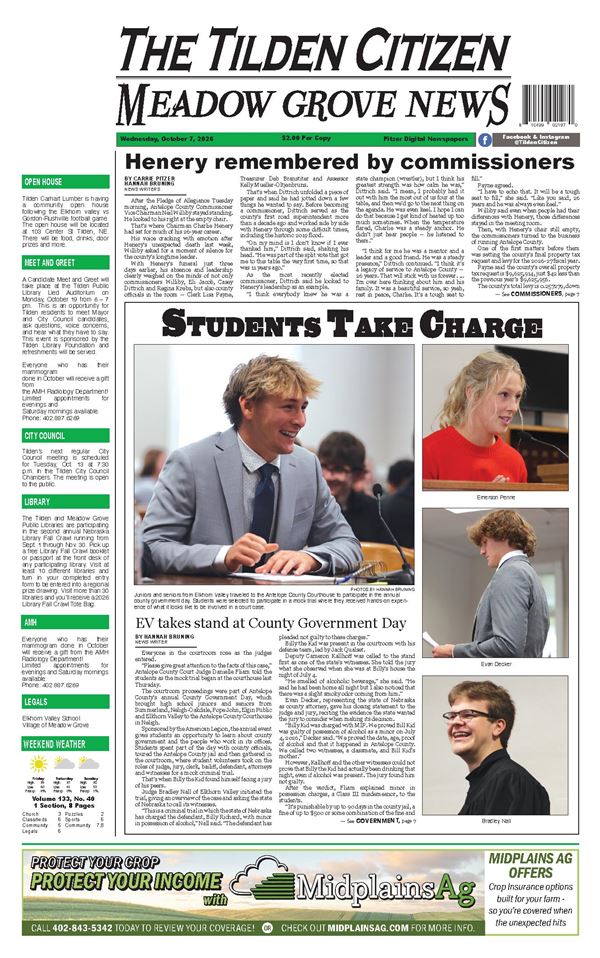
Zach Miller has lived in Neligh for 22 years of his life. One of the reasons he's chosen to stay in this community instead of moving to a bigger city is — privacy. He told Antelope County Commissioners he feels an invasion of his privacy since . ock cameras have been erected. Flock Cameras are automated license plate reader (ALPR) systems distributed and made by Flock Safety.
They track and log vehicle details in a national database.
"I'm basically asking for these to be taken down because I feel like they violate our privacy rights," he said Tuesday morning. “I understand that license plates are public knowledge, but most . ock cameras are built with an AI super center that is supposed to learn pattern recognition." Miller said even though the data gets deleted, AI keeps a record of patterns which he said leaves him and others concerned about who actually has access to these cameras and the data being stored.
Sheri Bob Moore assured Miller, the commissioners and the public that if data is being stored, further access to the data goes beyond the sheri 's o$ ce and to Flock Safety.
Moore also confi rmed the locations of the cameras. As of right now, there are four in Antelope County — one in Orchard, Plainview, Tilden and Clearwater. Miller wants there to be none. The installation of local . ock cameras took place almost three years ago, as they're currently in the third term for their contract with Flock Safety. The only cameras OK'd by the commissioners and sheri 's o$ ce were the four scattered throughout Antelope County communities.
However, Miller noted three other cameras in Neligh. Miller shared similar concerns about the . ock cameras during last month's Neligh City Council meeting.
The commissioners said they're unaware of who approved the installation of those, and who owns them.
The county sheri said if invasion of privacy is a concern, it's cellular phones that are a bigger issue.
“That phone is probably the biggest breach of security in a person's personal life," Moore said. "Wherever you go, it's tracking you." Contrary to Miller's concerns, Moore brought up the tracking that goes on with a cell phone — and how easily hackers can get into one to steal personal information.
Moore also brought up several stoplights in cities having cameras on them, and how the information the sheri 's o$ ce is using from these cameras is solely for the purpose of having an extra tool in their toolbox to track stolen vehicles, stolen plates, missing people and the like.
In fact, during the month of August the sheriff’s office received nine tips scattered across all four cameras. These included stolen plates, stolen vehicles, protection order violations and a missing person tip. But the biggest one Sheriff Moore said, was the tip of a registered sex offender entering Antelope County.
“It’s a huge tool for us,” Moore said. “It’s like somebody on patrol out there for us . . . I understand what they are trying to say but we are moving towards a digital world.”
Moore said the cameras aided in locating a missing 12-year-old. He said in Colorado, a murder suspect was captured and just made national news. The data to confirm both of these cases was pulled solely from the data the cameras were collecting.
“I can assure you what we’re entering and what we’re looking at. . . we were tracking the young man who went missing in Brunswick,” Moore said. “We entered his plate on his car and all of a sudden we found out he’s gone through Norfolk, now he’s went east of Norfolk and he was at Maskenthine Lake, where he was found.”
Despite Moore’s positive’s, Miller still voiced concerns. He questioned how many vehicles were referenced in search of one man, specifically the Brunswick man. When entering the vehicle information, were multiple different profiles brought up and tracked just to try to get one man’s information?
That information that can be accessed nationally, not just in Antelope County.
“We need to keep our information local,” Miller said.
Moore assured Miller that the Nebraska State Patrol wouldn’t keep using the system if they knew it was consistently being misused or hacked.
“If the state patrol knew there were breaches or people misusing it, they would shut it down in a heartbeat,” he said.
Commissioner Casey Dittrich brought up points for both sides, noting one of the biggest selling points for the camera is vehicle thefts, especially for Antelope County. He understands why Miller is presenting his concerns, but he and the commissioners agreed they don’t have enough factual information about the cameras to make a decision whether to take them down or not.
He said this isn’t just a local concern; it’s national.
“At the time, the benefit outweighed the cost in my opinion, or I wouldn’t have voted for it,” Dittrich said.
From what he does know, Dittrich said there are currently over 600 flock cameras across Nebraska. It’s not just Antelope County making a switch over to more of the digital world; it’s the nation.
The commissioners said at some point they’ll have to consider if the cameras are worth the money going into with how much data they’re giving back to the county. The world is moving more digital every day, and the sheriff’s department is trying to keep up with it.
But ultimately, they said it comes down to figuring out how secure the system is in protecting privacy.
Moore encouraged the commissioners to talk with the county attorney, present him with the state statutes regarding the flock cameras and gather more information before making an informed decision. The commissioners will meet again on Oct. 13 with Miller to go over their findings.
“You do your research and what you’re going to find out is right here, is your biggest invasion of privacy,” Moore said, holding up his cell phone in one hand.