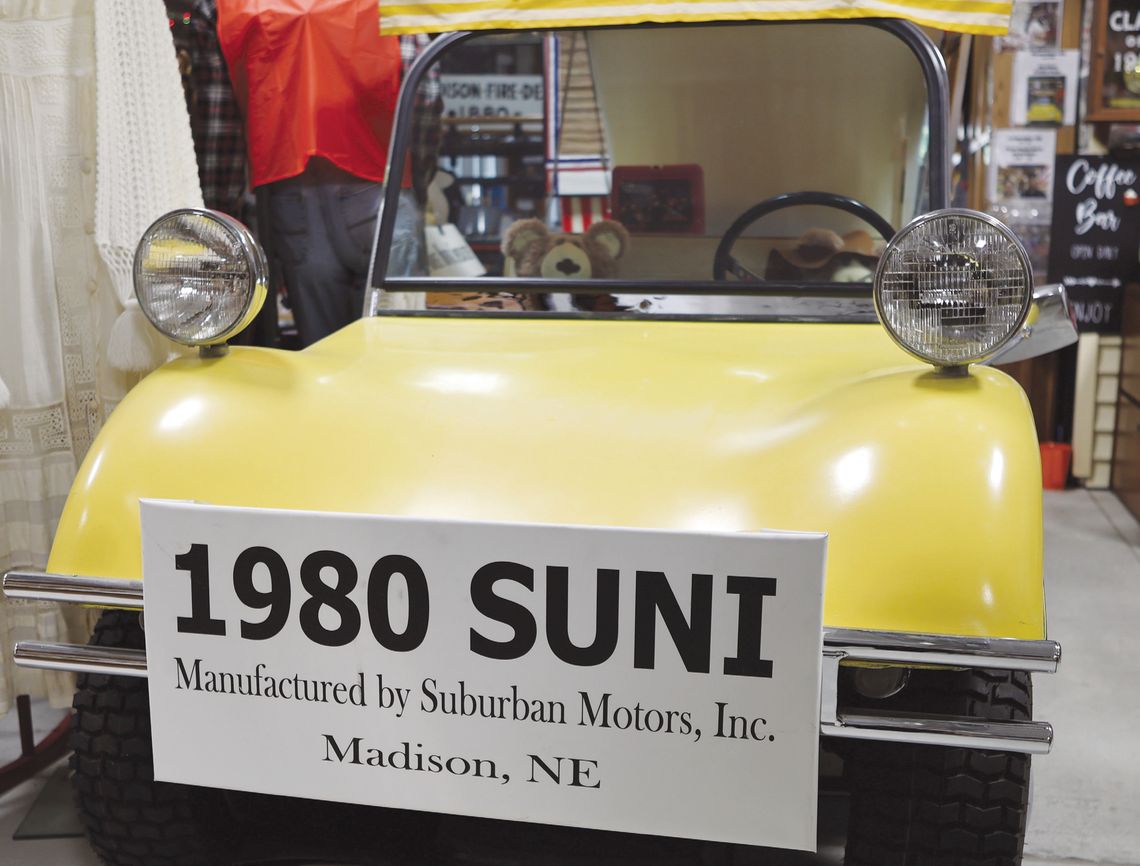
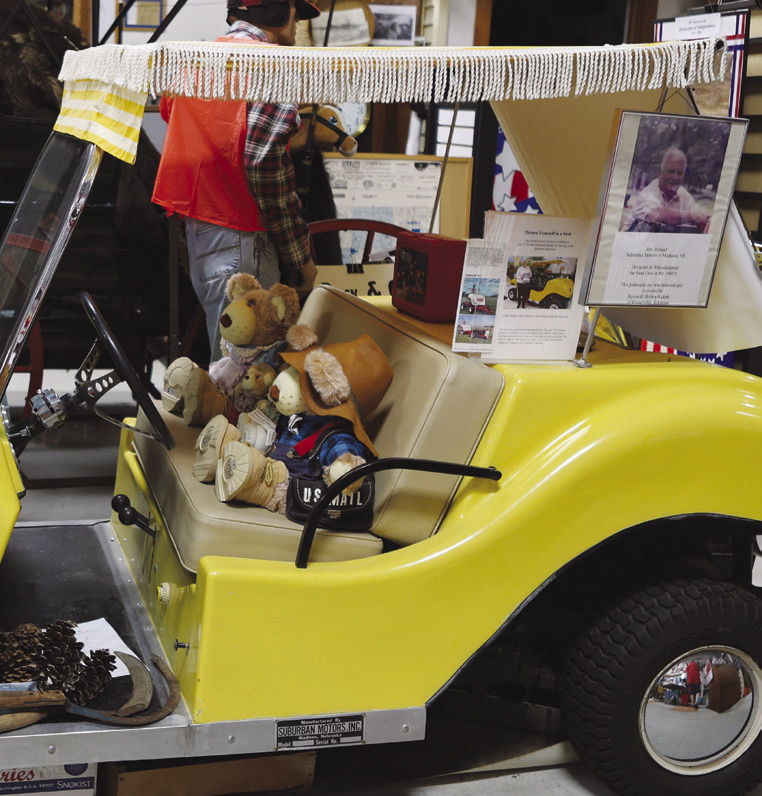
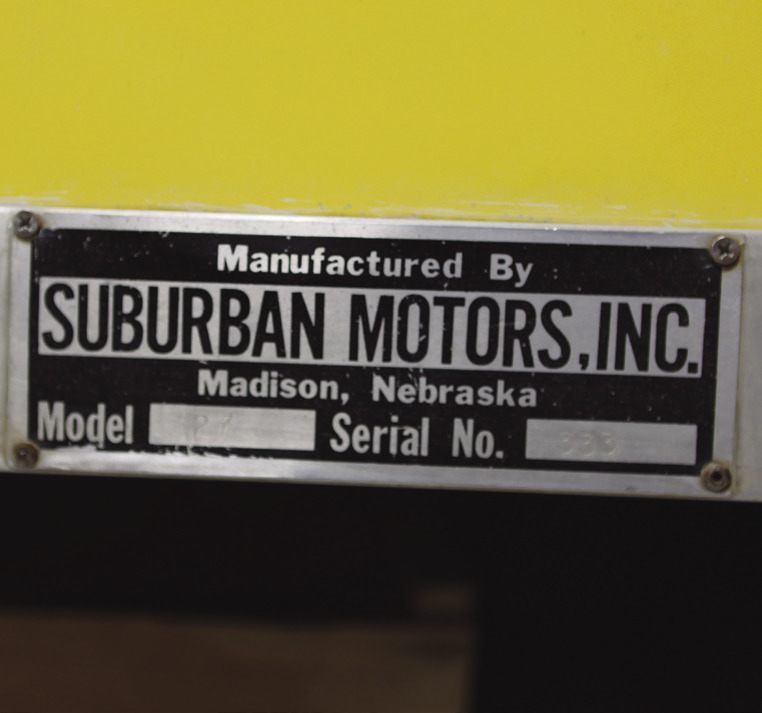
At first glance, the little yellow vehicle tucked inside the Madison County Historical Society Museum could easily be mistaken for a golf cart. But a small metal plate along its side tells a much more interesting story.
“Manufactured By Suburban Motors, Inc. Madison, Nebraska.”
Yes, Madison once built cars. And the story of how that happened begins with Kenneth “Jim” Housel, a Madison man who was always designing something.
His wife, Tillie, remembered that even as a young man, Jim liked geometry and was constantly sketching ideas. The two were high school sweethearts who married in 1952, and she recalled they couldn’t go into a restaurant with paper napkins without Jim drawing something on them.
Looking back years later, Tillie described her husband as a genius. At the time, though, she didn’t think much about all those drawings.
It was “just Jim.” Those drawings eventually became much more than sketches on napkins.
Shortly after they married, Jim and Tillie moved to Kansas City, where he worked for General Motors while the company had a government contract to produce airplanes. After that contract ended, the couple moved to Fullerton, California, where Jim worked for a tool and die company and enrolled in a mechanical engineering course through International Correspondence Schools. They later moved to Joplin, Missouri, where he worked for Rogers Iron Works and completed his mechanical engineering certificate.
Meanwhile, Tillie’s father, Glen McNall, was considering retirement from Madison Farm Equipment. In 1959, Jim and Tillie returned to Nebraska and purchased the business from him.
By 1966, the business was doing well enough that the Housels built a larger building along old Highway 81 near Madison. The additional space gave Jim room to experiment with the ideas that were seemingly always running through his mind.
In 1968, one of those ideas started taking the shape of a car.
Jim wasn’t necessarily a car enthusiast, according to Tillie. He was an entrepreneur who believed there was a market for something the major automobile manufacturers weren’t offering — a small, economical vehicle that didn’t require much gasoline.
He called his first car the Safari. Working in his Madison shop with help from area blacksmiths, Jim spent 1968 and 1969 designing and building it. The little fiberglass-bodied car weighed about 800 pounds, measured 112 inches long and 52 inches wide and was powered by a 12-horsepower engine. It could reportedly travel 40 to 50 mph while getting 40 to 50 miles per gallon.
Jim took the Safari to the Nebraska State There, he explained exactly why he thought America needed it.
Fair in 1969.
“We are proving it doesn’t take a 5,000 pound hunk of machine to take a 200 pound man to work or his 118 pound wife to the grocery store,” Housel told the Omaha World-Herald at the time.
The plan wasn’t simply to build a novelty.
Jim wanted to manufacture cars.
He entered into an agreement with Bill Larson, owner of UNeCO Inc. in Bellevue, to put the Safari into production. Housel told the World-Herald that 12 were expected to be built that September and then, as he put it, “we’ll take off from there.”
It didn’t work out that way. UNeCO eventually produced between 30 and 40 vehicles, but production problems plagued the partnership. Most were defective, according to the historical account, and the relationship between Housel and the company was dissolved.
Jim wasn’t ready to give up. Instead, he and Tillie sold their farm implement business and committed themselves full time to Suburban Motors.
Jim continued developing the Safari, designing and engineering nearly everything himself except the windshield, brakes and motor. He experimented with several engines before settling on a twocylinder, four-cycle Onan engine. The Safari was offered directly through Suburban Motors for $1,180.
The little Madison-built automobile attracted attention.
An advertisement in the Wall Street Journal generated more than 400 inquiries, and visitors regularly came through the doors at Suburban Motors.
But attention didn’t necessarily translate into sales.
Jim was also competing against an automobile industry that was beginning to move in his direction. Japanese manufacturers were gaining ground in the United States, gasoline shortages hit during the early 1970s and American manufacturers responded with smaller vehicles such as the AMC Gremlin, Ford Pinto and Chevrolet Vega.
Then federal regulations changed.
When Housel began producing the Safari, Suburban Motors qualified for exemptions from some federal requirements because it manufactured fewer than 500 vehicles a year and each weighed less than 1,000 pounds. When those rules changed in the early 1970s, Housel redesigned his car.
The Safari became the SUNI — pronounced “sunny.”
The SUNI could serve double duty. It was designed to be driven on the road but could also be used as a golf cart.
Which explains why the yellow one sitting in the Madison museum today looks so much like one.
In 1980, 35 SUNIs were sold to a retirement village in Hot Springs, Arkansas. That same year, Suburban Motors ended automobile production. Fewer than 500 of Housel’s cars were manufactured during the years he pursued his dream of building automobiles in Madison.
One of them eventually found its way home.
The bright yellow 1980 SUNI now displayed at the Madison County Historical Society Museum was restored and owned by Kevin and Shirley Kukuk of Russellville, Arkansas. The manufacturer’s plate identifies it as Model 27, Serial No. 333.
The odometer shows just 2,577 miles.
Although Housel’s dream of mass-producing automobiles never took off, his ability to design things did.
In 1970, a customer’s unusual request led Jim into experimenting with a paddle boat. Before long, Suburban Motors was manufacturing boats. The company built its first pontoons in 1971 and eventually moved from aluminum pontoons to foam-filled fiberglass hulls.
In 1976, Housel introduced the Performance pontoon, beginning years of continued experimentation and redesign.
Cars and boats weren’t the limits of his imagination, either.
After acquiring equipment to mold fiberglass in-house, Suburban Motors began taking custom orders. A 1988 Sioux City Journal article described a remarkably varied list of products made by the Madison company, including picnic tables, lawn ornament molds, ice fishing houses, pole-vaulting boxes, basketball backboards, duck pickers, machine hoods and fiberglass packing-house doors.
At its peak, Suburban Motors employed seven people in addition to Tillie, who served as the company’s bookkeeper.
Jim continued designing until near the end of his life. His final boat model, the Royal, was designed in 1989 and was his favorite style to use.
Jim died suddenly in February 1991.
Tillie and their son, James, tried to keep the business going after his death, but it was ultimately sold. The company eventually became the property of Apache Manufacturing in Hoskins, which continued manufacturing Performance pontoons.
Tillie died in 2019. Together, the Housels had spent decades turning Jim’s sketches into cars, boats and a small manufacturing business in Madison.
Jim may never have built the million cars he once dreamed about. In fact, Tillie kept a folder labeled “1st Million Car” for information about the Safari. She later joked that while they had hoped the name represented how much money they would make, it was probably closer to what they spent designing and developing the car.
More than four decades after the final SUNI was produced, however, one of Jim’s creations resides in the community where it began.
It sits inside the Madison museum, looking a little like a golf cart until someone gets close enough to read that small metal plate along its side — “Manufactured By Suburban Motors, Inc. Madison, Nebraska.”